Taking your pulse during physical activity allows you to measure how hard you are exercising. You should exercise to stay within your target heart range. • Use your index finger (食指) and middle finger. Don't use your thumb (拇指) -it has a pulse of its own. • Place these two fingers on your wrist, just below the base of the thumb. • Count the number of beats (pulses) for 15 seconds. • Take this number and multiply by 4 to find your heart rate in beats per minute. For example, if you count 25 beats, 25 x 4 = 100 beats per minute. Increasing your heart rate is a key part of exercise, but it is important that your heart rate is not too high or too low. If you are a beginner, you should also be able to breathe comfortably while exercising. This will ensure that you are exercising at a level that is safe and effective for your body. The chart below illustrates target heart rate ranges for exercise based on the maximal heart rate for selected ages. Here are the steps for using the chart: Measure your exercise heart rate in beats per minute (BPM). Look at the chart. - Find your age. If your age falls between the ages listed, round up to the next older age listed. - Compare your heart rate to the target exercise range. • If you are doing moderate exercise, your heart rate should be closer to the 50% range. • If you are doing vigorous exercise, your heart rate should be closer to the 85% range. • Try to stay in the 50-85% range when exercising by increasing or decreasing exercise intensity.TARGET HEART RATE RANGES BASEDON AGE-|||-Target Heart Rate Zone-|||-50%-85%of Maximum Heart Rate-|||-50% 70% 85% Maximum Heart-|||-(BPM) (BPM) (BPM) Rate(BPM)-|||-100 140 170 200-|||-98 137 166 195-|||-95 133 162 190-|||-93 130 157 185-|||-90 126 153 180-|||-88 123 149 175-|||-85 119 145 170-|||-83 116 140 165-|||-80 112 136 160(1)Which of the following is TRUE? ____ A. Exercise intensity can be reflected by a person's heart rate.B. The faster your heart rate is, the more effective the exercise is.C. Vigorous exercise will definitely present a threat to people's safety.D. The target exercise heart rate range for a 45-year-old is 90-149 BPM.(2)A 34-year-old man is running and the number of pulses he takes for 15 seconds is 40.His fitness coach had better tell him ____ .A. "You are doing fine."B. "You can run faster."C. "You should slow down a bit."D. "You should drink some water."(3)What is the purpose of this passage? ____ A. To advise people to form a habit of taking their pulses while exercising.B. To inform people of the target heart rate zone for those aged 60 and under.C. To tell people the importance of maintaining moderate amount of exercise.D. To show people how to measure heart rate to keep proper exercise intensity.
Taking your pulse during physical activity allows you to measure how hard you are exercising. You should exercise to stay within your target heart range.• Use your index finger (食指) and middle finger. Don't use your thumb (拇指) -it has a pulse of its own.
• Place these two fingers on your wrist, just below the base of the thumb.
• Count the number of beats (pulses) for 15 seconds.
• Take this number and multiply by 4 to find your heart rate in beats per minute. For example, if you count 25 beats, 25 x 4 = 100 beats per minute.
Increasing your heart rate is a key part of exercise, but it is important that your heart rate is not too high or too low. If you are a beginner, you should also be able to breathe comfortably while exercising. This will ensure that you are exercising at a level that is safe and effective for your body.
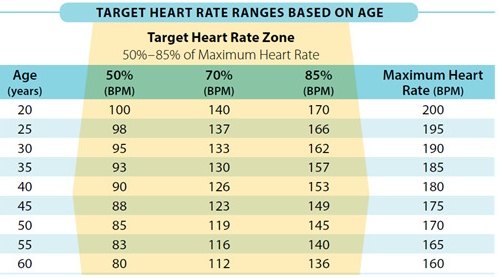
The chart below illustrates target heart rate ranges for exercise based on the maximal heart rate for selected ages. Here are the steps for using the chart:
Measure your exercise heart rate in beats per minute (BPM).
Look at the chart.
- Find your age. If your age falls between the ages listed, round up to the next older age listed.
- Compare your heart rate to the target exercise range.
• If you are doing moderate exercise, your heart rate should be closer to the 50% range.
• If you are doing vigorous exercise, your heart rate should be closer to the 85% range.
• Try to stay in the 50-85% range when exercising by increasing or decreasing exercise intensity.
(1)Which of the following is TRUE? ____
A. Exercise intensity can be reflected by a person's heart rate.
B. The faster your heart rate is, the more effective the exercise is.
C. Vigorous exercise will definitely present a threat to people's safety.
D. The target exercise heart rate range for a 45-year-old is 90-149 BPM.
(2)A 34-year-old man is running and the number of pulses he takes for 15 seconds is 40.His fitness coach had better tell him ____ .
A. "You are doing fine."
B. "You can run faster."
C. "You should slow down a bit."
D. "You should drink some water."
(3)What is the purpose of this passage? ____
A. To advise people to form a habit of taking their pulses while exercising.
B. To inform people of the target heart rate zone for those aged 60 and under.
C. To tell people the importance of maintaining moderate amount of exercise.
D. To show people how to measure heart rate to keep proper exercise intensity.
参考答案与解析:
-
相关试题
-
How often do you ______your brother?
-
[单选题]How often do you ______your brother?A.hear aboutB.hear ofC.hear toD.hear fr
- 查看答案
-
Dear Mary,How are you and your parents?
-
[单选题]D.ear Mary,H.ow are you and your parents? Did you ( 11) a good time last weekend? We had a day ( 12) from school this week. But I had a(n) ( 13) day.l got up early in the morning but the ( 14) was very bad.So I ( 15) to stay at home and help my mum d
- 查看答案
-
Your personal sense of photographic __ helps you determine how you will depict the subject and wheth
-
Your personal sense of photographic __ helps you determine how you will depict t
- 查看答案
-
– I wonder how much you charge for your
-
[单选题]– I wonder how much you charge for your services.-- The first two are free the third costs $30.A. whileB. untilC. whenD. before
- 查看答案
-
听力原文:W: How are you getting on with your
-
[单选题]听力原文:W: How are you getting on with your experiment?M: In spite of my continuous failure, I have already made some progress.What can we learn about the man's enperiment ?A.It is going on well.B.It has failed several times.C.It will soon be finished.
- 查看答案
-
How do you show your interest in the job
-
[单选题]H.ow do you show your interest in the job when your interview is about to be put an end?A.Raise questions about the employer or job.B.Express your thanks to the interviewer(s).C.Try to establish contact with the interviewer(s).D.Restate your interest
- 查看答案
-
()How do you spell your last name?
-
[问答题]()How do you spell your last name?
- 查看答案
-
()How long have you collected your stamps?
-
[问答题]()How long have you collected your stamps?
- 查看答案
-
How do you spell your last name?
-
[问答题]How do you spell your last name?
- 查看答案
-
How far can you advance with your curren
-
[主观题]H.ow far can you advance with your current employer?你在现在工作的单位里会有多大发展?
- 查看答案