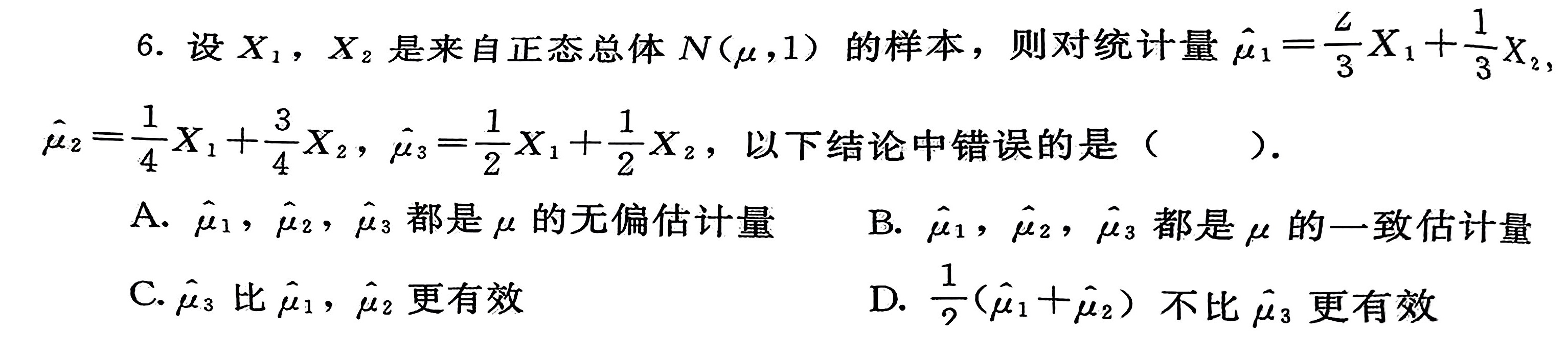
dfrac (1)(2)((overrightarrow {u)}_(1)+overrightarrow ({u)_(2)}) 不比μ3 更有效
参考答案与解析:
-
相关试题
-
已知晶体原胞基矢为:overrightarrow ({a)_(1)}=dfrac (a)(2)overrightarrow (i)+dfrac (sqrt {3)a}(2)overrightarrow
-
已知晶体原胞基矢为:overrightarrow ({a)_(1)}=dfrac (a)(2)overrightarrow (i)+dfrac (sqrt {3
- 查看答案
-
设overrightarrow(a)=(1,-1,2),overrightarrow(b)=(3,-2,-1),则overrightarrow(a)×overrightarrow(b)等于( )
-
设overrightarrow(a)=(1,-1,2),overrightarrow(b)=(3,-2,-1),则overrightarrow(a)×overr
- 查看答案
-
设单位向量overrightarrow(a),overrightarrow(b)与u轴的夹角分别为(2π)/(3),(π)/(4),则overrightarrow(a)-2overrightarrow
-
设单位向量overrightarrow(a),overrightarrow(b)与u轴的夹角分别为(2π)/(3),(π)/(4),则overrightarro
- 查看答案
-
已知overrightarrow (i)=(2,3,-1) , overrightarrow (i)=(2,3,-1),overrightarrow (i)=(2,3,-1),则overrightar
-
已知overrightarrow (i)=(2,3,-1) , overrightarrow (i)=(2,3,-1),overrightarrow (i)=(
- 查看答案
-
设overrightarrow(a)=(-1,1,2),overrightarrow(b)=(2,-2,-4),则向量|overrightarrow(a)×overrightarrow(b)|=( )
-
设overrightarrow(a)=(-1,1,2),overrightarrow(b)=(2,-2,-4),则向量|overrightarrow(a)×ov
- 查看答案
-
单选题 20/20 设overrightarrow(alpha_{1)}=(1,-1,2,-1),overrightarrow(alpha_{2)}=(-2,2,3,2),overrightarrow
-
单选题 20/20 设overrightarrow(alpha_{1)}=(1,-1,2,-1),overrightarrow(alpha_{2)}=(-2,2
- 查看答案
-
overrightarrow(a)=(1,0,1),overrightarrow(b)=(2,1,1),则overrightarrow(a)×overrightarrow(b)=( )
-
overrightarrow(a)=(1,0,1),overrightarrow(b)=(2,1,1),则overrightarrow(a)×overright
- 查看答案
-
设overrightarrow(a)=(1,1,4),overrightarrow(b)=(1,-2,2),则overrightarrow(a)+overrightarrow(b)在overright
-
设overrightarrow(a)=(1,1,4),overrightarrow(b)=(1,-2,2),则overrightarrow(a)+overrig
- 查看答案
-
设向量 overrightarrow (a)=(1,2,3) 、 overrightarrow (b)=(2,0,1), 则向量 overrightarrow (a)times overrightar
-
设向量 overrightarrow (a)=(1,2,3) 、 overrightarrow (b)=(2,0,1), 则向量 overrightarrow
- 查看答案
-
若向量 overrightarrow(AB)=(-1,2), overrightarrow(BC)=(3,-2), 则 overrightarrow(AC) 等于
-
若向量 overrightarrow(AB)=(-1,2), overrightarrow(BC)=(3,-2), 则 overrightarrow(AC) 等
- 查看答案