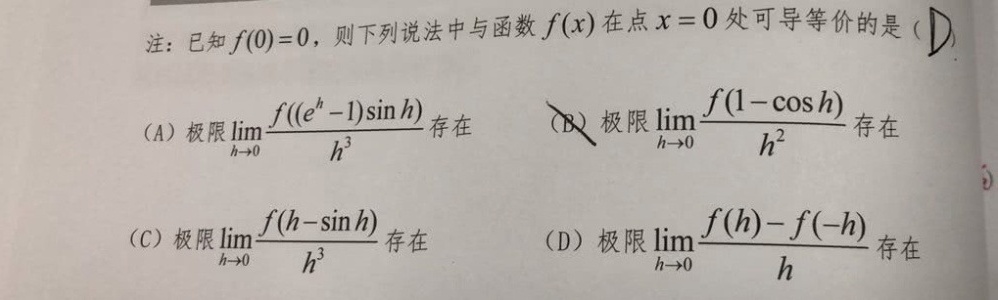
注:已知 (0)=0, 则下列说法中与函数f(x)在点 x=0 处可导等价的是 ()-|||-(A)极限 lim _(harrow 0)dfrac (f(({e)^h-1)sin h)}({h)^3} 存在-|||-(B)极限 lim _(harrow 0)dfrac (f(1-cos h))({h)^2} 存在-|||-(C)极限 lim _(harrow 0)dfrac (f(h-sin h))({h)^3} 存在-|||-(D)极限 lim _(harrow 0)dfrac (f(h)-f(-h))(h) 存在
参考答案与解析:
-
相关试题
-
已知函数f(x)在点x0处可导,则下列极 限 中 () 等于导数值f`(x0).-|||-(A) lim _(harrow 0)dfrac (f({x)_(0)+2h)-f((x)_(0))}(h)
-
已知函数f(x)在点x0处可导,则下列极 限 中 () 等于导数值f`(x0).-|||-(A) lim _(harrow 0)dfrac (f({x)_(0)
- 查看答案
-
(2)已知f(x)在 =(x)_(0) 处可导,且有 lim _(harrow 0)dfrac (2h)(f({x)_(0))-f((x)_(0)-4h)}=-dfrac (1)(4) 则-|||-&
-
(2)已知f(x)在 =(x)_(0) 处可导,且有 lim _(harrow 0)dfrac (2h)(f({x)_(0))-f((x)_(0)-4h)}=-
- 查看答案
-
若极限lim _(harrow 0)dfrac (f({x)_(0)+2h)-f((x)_(0))}(h)=dfrac (1)(2),则导数值lim _(harrow 0)dfrac (f({x)_(
-
若极限lim _(harrow 0)dfrac (f({x)_(0)+2h)-f((x)_(0))}(h)=dfrac (1)(2),则导数值lim _(har
- 查看答案
-
(1)若f(x)在 =(x)_(0) 处可导,则 () .-|||-(A) lim _(harrow 0)dfrac (f({x)_(0)+2h)-f((x)_(0))}(h)=f'((x)_
-
(1)若f(x)在 =(x)_(0) 处可导,则 () .-|||-(A) lim _(harrow 0)dfrac (f({x)_(0)+2h)-f((x)_
- 查看答案
-
若函数f(x)在点x0处可导,则极限underset(lim)(h→0)(f((x)_(0)+3h)-f((x)_(0)-h))/(2h)=( )
-
若函数f(x)在点x0处可导,则极限underset(lim)(h→0)(f((x)_(0)+3h)-f((x)_(0)-h))/(2h)=( )A. 4f′(
- 查看答案
-
(f(x)在 _{0)=(x)_(0) 处可导,且 lim _(harrow 0)dfrac (f({x)_(0)+2h)-f((x)_(0)-h)}(2h)= () .-|||-
-
(f(x)在 _{0)=(x)_(0) 处可导,且 lim _(harrow 0)dfrac (f({x)_(0)+2h)-f((x)_(0)-h)}(2h)=
- 查看答案
-
(6)设f(x)在x0处可导,则 lim _(harrow 0)dfrac (f({x)_(0)+h)-f((x)_(0)-h)}(h)= () ;-|||-(A)f`(x0) (B)2f`(x0)-
-
(6)设f(x)在x0处可导,则 lim _(harrow 0)dfrac (f({x)_(0)+h)-f((x)_(0)-h)}(h)= () ;-|||-(
- 查看答案
-
[题目]设函数f (x)在 x=0 处连续,且 lim _(harrow 0)dfrac (f({h)^2)}({h)^2}=1,-|||-则 ()-|||-
-
[题目]设函数f (x)在 x=0 处连续,且 lim _(harrow 0)dfrac (f({h)^2)}({h)^2}=1,-|||-则 ()-|||-
- 查看答案
-
设函数f(x)满足lim _(harrow 0)dfrac (1)(h)[ f(5-dfrac (1)(3)h)-f(5)] =2,则lim _(harrow 0)dfrac (1)(h)[ f(5-
-
设函数f(x)满足lim _(harrow 0)dfrac (1)(h)[ f(5-dfrac (1)(3)h)-f(5)] =2,则lim _(harrow
- 查看答案
-
lim _(harrow 0)dfrac (f({x)_(0)+h)-f((x)_(0)-h)}(h) 存在是f(x)在x 0点可导的 () 条件.-|||-(A)充分必要;(B )必要非充分;(C
-
lim _(harrow 0)dfrac (f({x)_(0)+h)-f((x)_(0)-h)}(h) 存在是f(x)在x 0点可导的 () 条件.-|||-(
- 查看答案