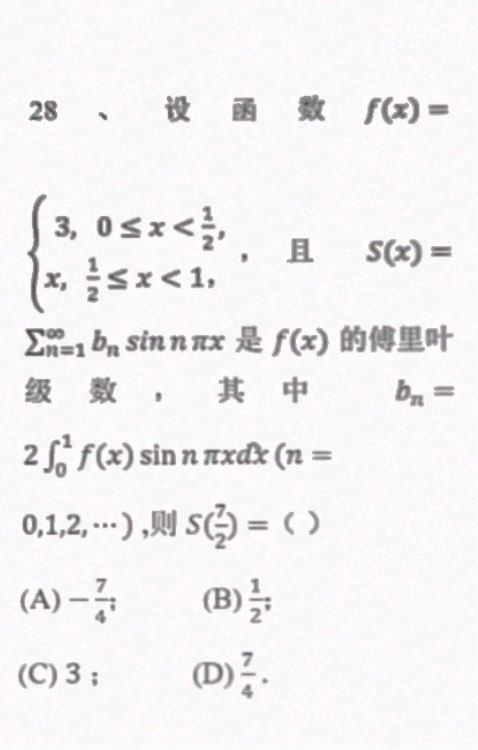
x,dfrac {1)(2)leqslant xlt 1,
参考答案与解析:
-
相关试题
-
【题目】-|||-设总体X的概率密度为-|||-(x;theta )= ,0lt xlt theta dfrac {1)(2(1-theta )),theta leqslant xlt 1 .
-
【题目】-|||-设总体X的概率密度为-|||-(x;theta )= ,0lt xlt theta dfrac {1)(2(1-theta )),the
- 查看答案
-
设总体X的概率密度为-|||-(x;theta )= ,0lt xlt theta dfrac {1)(2(1-theta )),theta leqslant xlt 1 0,) 是否为θ^2)
-
设总体X的概率密度为-|||-(x;theta )= ,0lt xlt theta dfrac {1)(2(1-theta )),theta leqsla
- 查看答案
-
1 已知随机变量X的概率密度为-|||-f(x)= ) x,0leqslant xlt 1, 2-x,1leqslant xlt 2, 0, .
-
1 已知随机变量X的概率密度为-|||-f(x)= ) x,0leqslant xlt 1, 2-x,1leqslant xlt 2, 0, .
- 查看答案
-
1 已知随机变量X的概率密度为-|||-.f(x)= ) x,0leqslant xlt 1, 2-x,1leqslant xlt 2, 0, -
-
1 已知随机变量X的概率密度为-|||-.f(x)= ) x,0leqslant xlt 1, 2-x,1leqslant xlt 2, 0, -
- 查看答案
-
1.已知随机变量X的概率密度为-|||-f(x)= ) x,0leqslant xlt 1, 2-x,1leqslant xlt 2, 0, .
-
1.已知随机变量X的概率密度为-|||-f(x)= ) x,0leqslant xlt 1, 2-x,1leqslant xlt 2, 0, .
- 查看答案
-
1.已知随机变量X的概率密度为-|||-f(x)= ) x,0leqslant xlt 1, 2-x,1leqslant xlt 2, 0, .
-
1.已知随机变量X的概率密度为-|||-f(x)= ) x,0leqslant xlt 1, 2-x,1leqslant xlt 2, 0, .
- 查看答案
-
设(x)=((2-x))^tan dfrac (pi {2)x},(dfrac (1)(2)lt xlt 1),求(x)=((2-x))^tan dfrac (pi {2)x},(dfrac (1)(
-
设(x)=((2-x))^tan dfrac (pi {2)x},(dfrac (1)(2)lt xlt 1),求(x)=((2-x))^tan dfrac (
- 查看答案
-
已知 f(x)= ) (x)^2,0leqslant xlt 1 1,1leqslant xleqslant 2,f(t)dt(0leqslant xleqslant 2), 则
-
已知 f(x)= ) (x)^2,0leqslant xlt 1 1,1leqslant xleqslant 2,f(t)dt(0leqslant xleq
- 查看答案
-
设 f(x)= ) x-1,-1leqslant xleqslant 0 x+2,0leqslant xleqslant 1 (2)^x,1lt xlt 3 .
-
设 f(x)= ) x-1,-1leqslant xleqslant 0 x+2,0leqslant xleqslant 1 (2)^x,1lt xlt 3
- 查看答案
-
证明:ln dfrac (1+x)(1-x)+cos xgeqslant 1+dfrac ({x)^2}(2) -1lt xlt 1.
-
证明:ln dfrac (1+x)(1-x)+cos xgeqslant 1+dfrac ({x)^2}(2) -1lt xlt 1.证明:.
- 查看答案