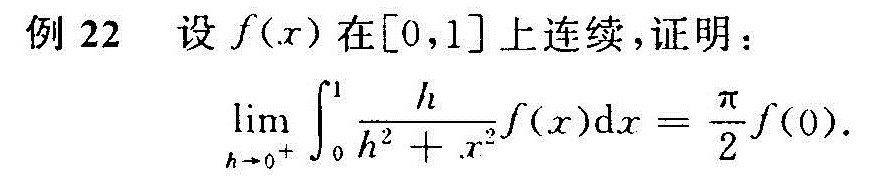
例22 设f(x)在[0,1]上连续,证明:-|||-lim _(harrow {0)^+}(int )_(0)^1dfrac (h)({h)^2+(x)^2}f(x)dx=dfrac (pi )(2)f(0).
参考答案与解析:
-
相关试题
-
若极限lim _(harrow 0)dfrac (f({x)_(0)+2h)-f((x)_(0))}(h)=dfrac (1)(2),则导数值lim _(harrow 0)dfrac (f({x)_(
-
若极限lim _(harrow 0)dfrac (f({x)_(0)+2h)-f((x)_(0))}(h)=dfrac (1)(2),则导数值lim _(har
- 查看答案
-
[题目]设函数f (x)在 x=0 处连续,且 lim _(harrow 0)dfrac (f({h)^2)}({h)^2}=1,-|||-则 ()-|||-
-
[题目]设函数f (x)在 x=0 处连续,且 lim _(harrow 0)dfrac (f({h)^2)}({h)^2}=1,-|||-则 ()-|||-
- 查看答案
-
设函数f(x)满足lim _(harrow 0)dfrac (1)(h)[ f(5-dfrac (1)(3)h)-f(5)] =2,则lim _(harrow 0)dfrac (1)(h)[ f(5-
-
设函数f(x)满足lim _(harrow 0)dfrac (1)(h)[ f(5-dfrac (1)(3)h)-f(5)] =2,则lim _(harrow
- 查看答案
-
2、设f(x)在区间[0,1]上可导, (1)=2(int )_(0)^dfrac (1{2)}(x)^2f(x)dx, 证明:存在 varepsilon in (0,1),-|||-使得 (xi )
-
2、设f(x)在区间[0,1]上可导, (1)=2(int )_(0)^dfrac (1{2)}(x)^2f(x)dx, 证明:存在 varepsilon in
- 查看答案
-
(2)已知f(x)在 =(x)_(0) 处可导,且有 lim _(harrow 0)dfrac (2h)(f({x)_(0))-f((x)_(0)-4h)}=-dfrac (1)(4) 则-|||-&
-
(2)已知f(x)在 =(x)_(0) 处可导,且有 lim _(harrow 0)dfrac (2h)(f({x)_(0))-f((x)_(0)-4h)}=-
- 查看答案
-
(f(x)在 _{0)=(x)_(0) 处可导,且 lim _(harrow 0)dfrac (f({x)_(0)+2h)-f((x)_(0)-h)}(2h)= () .-|||-
-
(f(x)在 _{0)=(x)_(0) 处可导,且 lim _(harrow 0)dfrac (f({x)_(0)+2h)-f((x)_(0)-h)}(2h)=
- 查看答案
-
(1)若f(x)在 =(x)_(0) 处可导,则 () .-|||-(A) lim _(harrow 0)dfrac (f({x)_(0)+2h)-f((x)_(0))}(h)=f'((x)_
-
(1)若f(x)在 =(x)_(0) 处可导,则 () .-|||-(A) lim _(harrow 0)dfrac (f({x)_(0)+2h)-f((x)_
- 查看答案
-
设f(x)为连续函数,则(int )_(0)^1f'(dfrac (x)(2))dx等于( ).(int )_(0)^1f'(dfrac (x)(2))dx
-
设f(x)为连续函数,则(int )_(0)^1f(dfrac (x)(2))dx等于( ).(int )_(0)^1f(dfrac (x)(2))dx设f(x
- 查看答案
-
[例9]设f(x)在[0,1]上连续, (0)=0, (int )_(0)^1f(x)dx=0.-|||-求证:存在 xi in (0,1), 使 (int )_(0)^pi f(x)dx=xi f(
-
[例9]设f(x)在[0,1]上连续, (0)=0, (int )_(0)^1f(x)dx=0.-|||-求证:存在 xi in (0,1), 使 (int )
- 查看答案
-
(6)设f(x)在x0处可导,则 lim _(harrow 0)dfrac (f({x)_(0)+h)-f((x)_(0)-h)}(h)= () ;-|||-(A)f`(x0) (B)2f`(x0)-
-
(6)设f(x)在x0处可导,则 lim _(harrow 0)dfrac (f({x)_(0)+h)-f((x)_(0)-h)}(h)= () ;-|||-(
- 查看答案